Designer's Guide to Dual-Sided Elastic Engineering for High-End Innerwear
Consumers wearing high-end close-fitting innerwear often experience skin redness and irritation not from fit issues, but from the elastic itself, specifically, the roughness or repetitive friction of elastic band edges against the underbust, shoulders, or waist over the course of a full day. A well-engineered brassiere elastic band has to play two distinct roles simultaneously: the outer face must maintain the tension needed to support the garment's silhouette, while the inner face, the surface in direct contact with skin, must remain consistently gentle under constant, high-frequency movement.
Dual-sided differentiated manufacturing addresses this directly. By applying distinct techniques and material ratios to the front and back of an elastic band, it becomes possible to optimize the skin-contacting face for comfort without compromising the durability and structural performance of the outer face. This piece breaks down how that engineering works in practice, across construction, material selection, and application.
How dual-sided craftsmanship works
Dual-sided webbings use different weaving structures or materials on the outer face versus the inner skin-contacting face. This breaks through the core limitation of traditional webbings, where high durability and a smooth skin-contacting surface have historically been difficult to achieve in the same construction.
ECI optimises the physical friction coefficient of the inner face through two core technologies:
Outer functional layer: A high-density, high-tension weave engineered specifically to bear elongation, recovery, and structural support requirements, while providing the surface quality needed for brand jacquards and visual design elements.
Inner skin-contacting layer, two approaches:
- Precision back-brushed technology: A controlled brushing process applied to the skin-facing side creates an extremely fine micro-fleece surface, significantly enhancing skin affinity and softness without affecting the outer structure.
- Fine denier (microfiber) interwoven technology: Micro-scale ultra-fine fiber yarns are precisely interwoven into the inner face during the weaving process. The result is a silky, voluminous, highly breathable surface with a hand-feel that's soft enough to be imperceptible against skin.
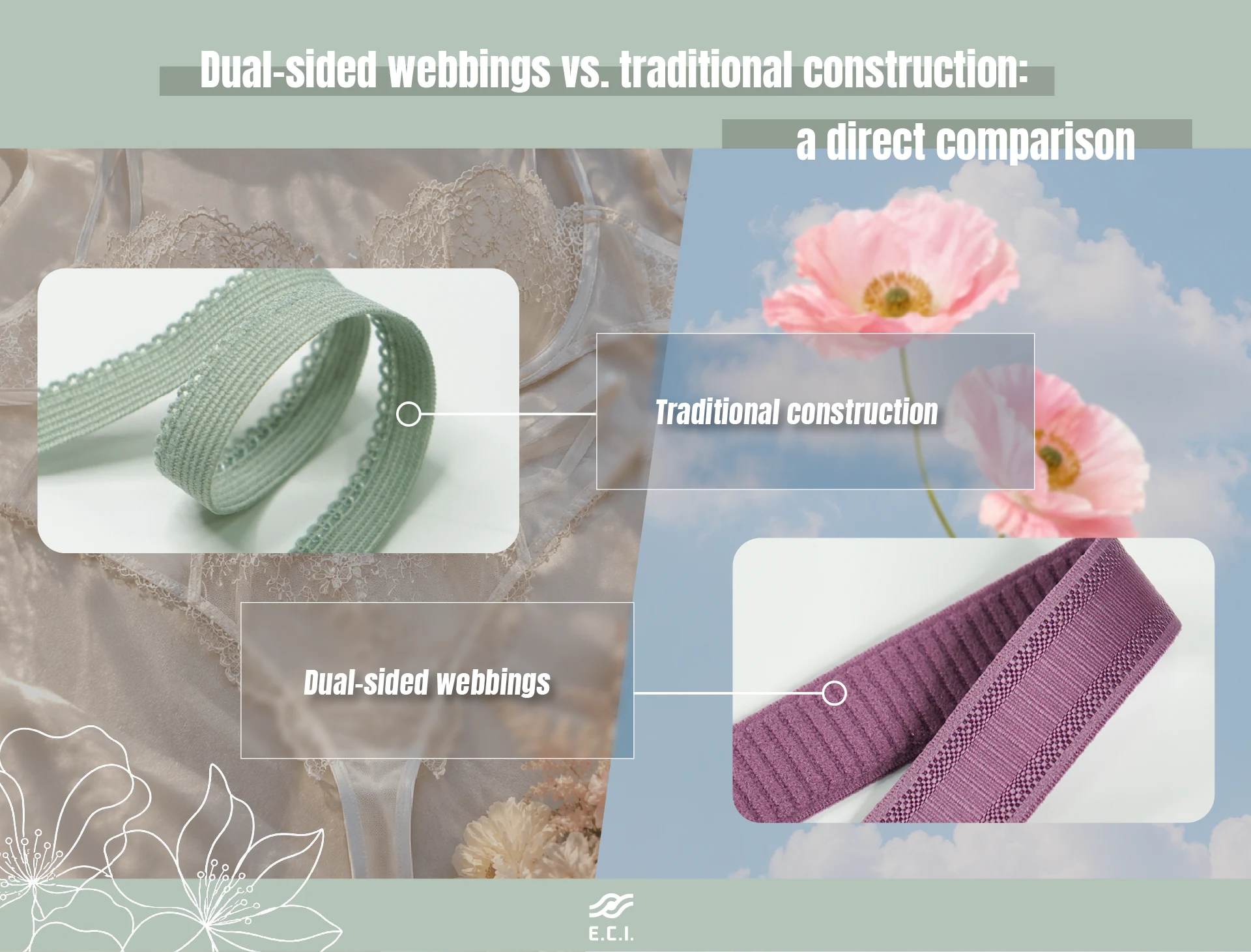
Dual-sided webbings vs. traditional construction: a direct comparison
Traditional webbings have essentially identical structures on both faces. When facing the skin-affinity requirements of high-end intimate apparel, that uniformity forces a compromise, either the construction is stiff enough to support the silhouette, or it's soft enough to be comfortable. Rarely both.
|
Evaluation Item |
Dual-Sided Webbings (Back-Brushed / Fine Denier Interwoven) |
Traditional Webbings |
Structural Impact |
|
Skin-contacting face hand-feel |
Extremely low friction — micro-fleece or fine denier yarn delivers a silky, voluminous feel |
Medium to high — traditional tension structures result in a stiffer surface |
Directly affects skin affinity and likelihood of redness or irritation during extended wear |
|
Outer silhouette support |
High — front face maintains a high-density elastic structure for load-bearing |
Linked to overall structural stiffness — softness requires sacrificing tension |
Determines structural crispness and functional performance of the finished garment |
|
Post-wash curling and deformation |
Low — precise tension balance calculations maintain structural stability |
Medium to high — edges prone to slackening and hardening after repeated stretching |
Affects garment lifespan and downstream customer complaint rates |
|
Design and budget flexibility |
High — brushing or premium yarn applied locally to the back face only |
Low — composition must remain consistent throughout, making cost control difficult |
A critical factor when balancing production cost against hand-feel optimisation |
Application: where dual-sided construction matters most
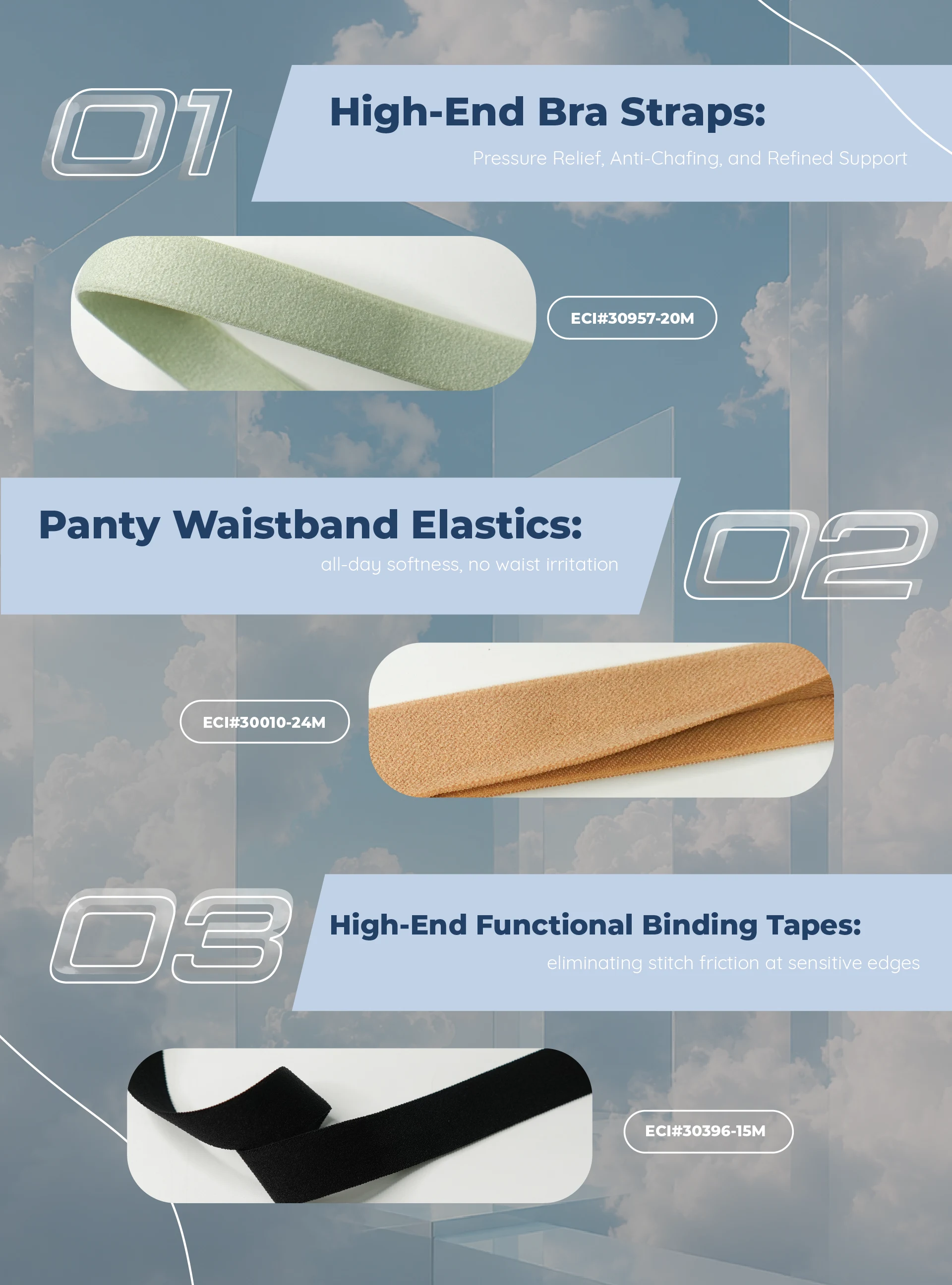
This engineering approach is most consequential in three high-friction zones in close-fitting innerwear. Designers can calibrate the exclusive hand-feel by selecting between the Back-Brushed Series or the Fine Denier Microfiber Series based on product positioning.
1. High-end bra straps: pressure relief, anti-chafing, refined support
Recommended products: 30957-20M / 33999-12M
Bra straps carry the primary load of bust support. Under strong tension, traditional high-elasticity straps can dig into the shoulder and leave visible red marks. With dual-sided construction, the outer face maintains stable physical rebound while the inner face conforms to shoulder skin via fine denier microfibers or micro-fleece brushing. This distributes shoulder pressure more evenly, substantially reduces chafing during movement, and delivers a consistently silky tactile feel throughout the day.
2. Panty waistband elastics: all-day softness, no waist irritation
Recommended products: 30010-24M / 37758-30M
A waistband elastic with an inferior structure will harden and curl at the edges after laundering, eventually leaving deep indentations on the waist and abdomen. By applying high tensile strength to the front face and extreme brushing or fully interwoven fine denier yarn to the back face, the outer surface maintains a crisp visual appearance while the skin-contacting face provides soft, all-around wrapping — delivering a seamless, non-irritating experience that also prevents the garment from shifting during wear.
3. High-end functional binding tapes: eliminating stitch friction at sensitive edges
Recommended products: 22811-6M / 30396-15M
Bra cup edges, side wings, underarms, and necklines are subjected to the most frequent friction during movement. Applying back-brushing or fine denier interweaving to binding tapes allows the high-tenacity structure to wrap cleanly around raw fabric edges and seams — preventing stiff sewing threads from contacting the skin directly, and minimising the friction resistance generated by repeated physical activity.
Technical FAQ
Q1: Does the structural variation between front and back faces cause dual-sided webbings to curl or deform more easily?
No — and this is precisely where ECI's technical expertise is concentrated. During weaving and post-processing, we perform precise tension balance calculations between the external functional tension and the internal skin-friendly structure. Even after specialised back-side processing, the webbing maintains structural stability: it stays crisp after laundering and resists the curling that would otherwise create additional skin friction points.
Q2: How can brands use a customised dual-sided ratio to balance hand-feel with development budget?
The construction logic here works in a brand's favour. High-specification fine denier microfibers can be concentrated precisely on the inner skin-contacting face, while the outer face — responsible for silhouette and structural support — uses functional but cost-efficient elastic yarns. This means brands don't need to apply premium materials throughout the full webbing to achieve a premium skin-feel. ECI can guide that ratio to match your hand-feel brief and budget parameters.
Q3: Will back-brushed or fine denier interwoven webbings lose their skin affinity or develop pilling after long-term laundering?
Both technologies hold up well under repeated machine washing. ECI's brushing process is strictly controlled to ensure uniform micro-fleece length and secure adhesion. Fine denier microfiber yarns are selected for their tensile strength and abrasion resistance alongside their softness — specifications consistently tested to meet the washing stability requirements of major international brands. Under repeated laundering cycles, these constructions resist elastic fatigue, fiber shedding, and the edge pilling that can cause itching.
Q4: For consumers whose skin is prone to redness and allergic reactions from elastic bands, how should designers select the appropriate back-side construction?
The right choice depends on the garment's structural requirements. For designs requiring stronger external support alongside a gentle, micro-fleece skin touch — such as high-support bras or athletic innerwear — a configuration of strong front tension paired with back-brushing is recommended. For products targeting an overall lightweight, silky, highly breathable hand-feel — such as loungewear or lounge intimates — back-interwoven fine denier microfiber technology is the better fit, leveraging the material's lower friction coefficient for improved skin adaptability.
Working with ECI on dual-sided development
The most meaningful details in a finished garment are often the ones consumers feel rather than see. ECI's narrow fabric and elastic engineering is built around resolving the tension between functional support and next-to-skin comfort — through both precision back-brushing and fine denier microfiber interweaving, applied in the ratios that best match each brand's product brief and cost parameters.
Whether you're developing high-end bra straps, panty waistbands, or high-performance apparel binding tapes, ECI can tailor samples to your specifications. Contact our team to discuss your requirements and begin sample development.