Certifications & Compliance
Certification Overview
The following table summarizes ECI’s current certifications and compliance programs across our global manufacturing network.
Oeko-Tex Standard 100
Product safety — harmful substance testing
ISO 9001
Quality management systems
Higg FEM
Facility environmental performance
GRS (Global Recycled Standard)
Recycled content verification & chain of custody
ZDHC MRSL
Chemical management (Manufacturing Restricted Substances List)
SLCP
Social & labor convergence assessment
BVE3 Platform
Chemical management platform membership
Certifications & Compliance
Our Approach to Certification
At ECI, certifications are not checkboxes. They are the documented evidence of how we build products and run facilities every day. When a brand partner asks us to verify a claim, whether that’s recycled content, chemical safety, or labor conditions, we don’t scramble to prepare for an audit. We hand over the same systems and data we use year-round.
This philosophy has guided our approach to compliance since we first pursued Oeko-Tex Standard 100 certification in 1999, one of the earliest elastic tape manufacturers in Asia to do so. In the decades since, as supply chain transparency has moved from a nice-to-have to a non-negotiable, we’ve added certifications not reactively but proactively, anticipating what our brand partners will need before their compliance teams come asking.
Today, ECI holds certifications across four pillars:
- Product Safety — ensuring our elastic tapes and trims are free from harmful substances
- Quality Systems — maintaining consistent, repeatable manufacturing processes
- Environmental Responsibility — measuring and reducing our manufacturing footprint
- Social Compliance — verifying fair labor practices across all facilities
Because ECI operates as a vertically integrated manufacturer—managing raw material sourcing, weaving, knitting, dyeing, finishing, and packaging entirely in-house—our certifications cover the full production chain under one roof. There are no subcontractor gaps. No undocumented handoffs. Every certification applies to every step of the process.
Four certified-recycled trim families, engineered to ship at scale.
Every construction is GRS-traceable from yarn through finished trim, with batch-level recycled-content reporting in your spec sheet.
Recycled Polyester Elastic
Among our most-ordered recycled constructions for major brand programs. Woven elastic tapes combine recycled polyester with elastane in smooth or matte finishes for back-neck applications, alongside a solid-color braided drawcord made with 100% recycled polyester. Clean interior finishing integrates recycled content without compromising everyday performance.
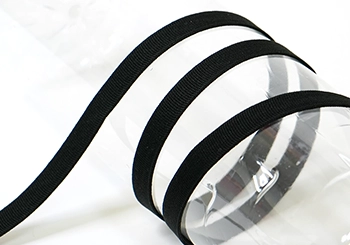
Fancy Yarn
Plied fancy yarns bring mélange and multi-color surfaces to trims designed to be seen. A 3/4" braided drawcord turns waistbands and hood details into visible design elements, while woven jacquard elastic waistband tape incorporates patterns—including logos—directly into the weave, eliminating the need for printing.
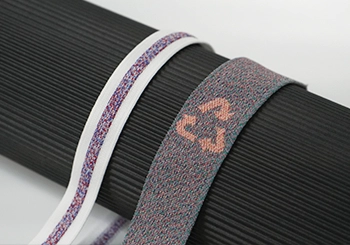
Acetate Frree Tips Drawcord
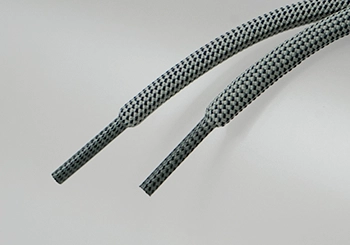
A drawcord tip designed without acetate film or film waste. Our TP104 tip is formed with bluesign® APPROVED WEL Resin H-96, eliminating acetate film cutting and laminating steps and reducing associated material loss and process waste. The slim 3/16" multi-color braid is built for outdoor jackets, pack cinches, and hardware points where cords are pulled hard and often, with a finished tip that keeps cord ends clean through repeated use.
Mechanical Stretch Tape
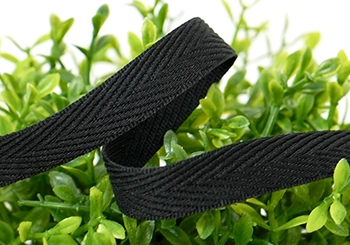
Stretch without elastane. This narrow woven tape uses a polyester textured-yarn construction in which the yarn structure provides mechanical stretch—no spandex and no fiber blend. Its polyester-only fiber construction supports polyester recycling pathways, while the matte, solid-color surface suits plackets, hems, and decorative lines on sportswear.
Oeko-Tex Standard 100
What It Certifies
Oeko-Tex Standard 100 is an independent testing and certification system for textile products at all stages of production. It tests for harmful substances including formaldehyde, heavy metals, pesticides, chlorinated phenols, phthalates, and allergenic dyes—verifying that finished products are safe for human contact.
Why It Matters for Elastic Trims
Elastic tapes sit directly against skin, often in sensitive zones like waistbands, bra bands, and underwear leg openings. The materials used in elastic production (rubber, elastane, dyes, finishes) must meet strict thresholds for skin safety. Oeko-Tex Standard 100 provides this assurance at the product level, independently verified rather than self-declared.
ECI's Oeko-Tex Certification
ECI first achieved Oeko-Tex Standard 100 certification in 1999, among the earliest narrow fabric manufacturers in Asia to do so, and has maintained continuous certification for over 25 years, with annual renewal testing across our full product range.
Rather than holding a single blanket certificate, ECI maintains four separate Oeko-Tex Standard 100 certifications, each covering a distinct material category:
- Virgin synthetic fibers (polyester and nylon)
- Virgin synthetic fibers (melting yarn)
- Recycled materials (polyester and nylon)
- Colored yarn
This structure means that every primary material input — including our recycled fiber range — carries its own independently verified certification, covering all product types across the ECI range: shoulder straps, binding tapes, waistbands, and beyond. For brand compliance teams, this provides material-level traceability rather than a single product-level declaration.
ECI's current certification can be verified independently via the Oeko-Tex Buying Guide.
ISO 9001: Quality Management
What It Certifies
ISO 9001 is the international standard for quality management systems (QMS). It provides a framework for consistent processes, documentation, continuous improvement, and customer focus across all organizational functions.
Why It Matters for Elastic Trims
Narrow fabrics require exceptional consistency. A waistband elastic that varies by even 2mm in width or 5% in stretch recovery creates downstream problems in garment production. ISO 9001 ensures that ECI’s manufacturing processes—from yarn tension settings to dye lot management to packaging specifications—are documented, monitored, and continuously refined.
ECI’s Implementation
Our QMS covers every facility and every stage: incoming material inspection, machine calibration, in-process quality checks, final product testing, and corrective action procedures. ISO 9001 forms the backbone of ECI’s ability to deliver millions of meters of elastic tape monthly with the consistency that global brands demand.
Higg FEM: Facility Environmental Module
What It Measures
The Higg Facility Environmental Module (Higg FEM), developed by the Sustainable Apparel Coalition, is a standardized sustainability assessment tool that measures a facility’s environmental performance across seven categories: Environmental Management Systems, Energy Use & Greenhouse Gases, Water Use, Wastewater, Emissions to Air, Waste Management, and Chemical Management.
Why It Matters for Elastic Trims
Major global brands require Higg FEM reporting from their supply chain partners. For trim suppliers like ECI, participation demonstrates that we meet the same environmental accountability standards as primary fabric mills—essential for brands pursuing science-based targets and transparent supply chain reporting.
ECI’s Participation
ECI has participated in the Higg FEM self-assessment since 2019, with verified assessments across our manufacturing facilities. Our scores inform our environmental improvement roadmap, including investments in energy efficiency, water recycling, and waste reduction programs.
In 2025, ECI achieved a 0.00 gap across every environmental category, meaning our self-reported data matched third-party verification exactly, with no discrepancies in any section.
|
FEM Section |
2025 Self-Assessment |
2025 Verified |
Gap |
|
Environmental Management System |
0.91 |
0.91 |
0.00 |
|
Energy & Greenhouse Gases |
0.29 |
0.29 |
0.00 |
|
Water Use |
0.25 |
0.25 |
0.00 |
|
Wastewater |
0.75 |
0.75 |
0.00 |
|
Air Emissions |
0.21 |
0.21 |
0.00 |
|
Waste Management |
0.71 |
0.71 |
0.00 |
|
Chemical Management |
0.29 |
0.29 |
0.00 |
A 0.00 gap across all seven sections means the data ECI reports internally is exactly what an independent auditor finds when they verify it on-site. For brand compliance teams, this is the practical measure of whether a supplier's environmental reporting can be trusted.
Read our full Higg FEM & Environmental Assessment page →GRS: Global Recycled Standard
What It Certifies
The Global Recycled Standard (GRS), administered by Textile Exchange, is an international standard that verifies recycled content in products, tracks recycled materials through the supply chain via chain-of-custody documentation, and sets requirements for social responsibility, environmental practices, and chemical restrictions.
Why It Matters for Elastic Trims
As brands extend their recycled content commitments to all garment components, not just shell fabrics—trims suppliers must provide the same level of verified documentation. GRS certification allows ECI’s recycled elastic tapes to be included in a garment’s total recycled content calculation, backed by transaction certificates for each shipment.
ECI’s GRS Certification
ECI achieved GRS certification progressively across all manufacturing facilities: Vietnam (2024), Zhuhai (2025), and Taiwan (2026). This makes ECI one of the few vertically integrated elastic tape manufacturers worldwide to hold GRS certification across its entire production network.
Read our full GRS & Recycled Elastic Tapes page →ZDHC: Zero Discharge of Hazardous Chemicals
What It Requires
The ZDHC Foundation’s Manufacturing Restricted Substances List (MRSL) goes beyond traditional product-based RSLs by controlling which chemicals can be used in manufacturing processes—not just what remains in finished goods. ZDHC compliance means that the dyes, auxiliaries, and finishing agents used in production meet strict hazard thresholds.
Why It Matters for Elastic Trims
Elastic tape manufacturing involves dyeing and finishing processes that use specialty chemicals. ZDHC compliance ensures these chemicals do not introduce hazardous substances into wastewater or factory environments—a requirement for brands committed to responsible chemical management across their entire supply chain, including trims.
ECI’s Compliance
ECI maintains ZDHC MRSL compliance across all dyeing and finishing operations. In 2023, we additionally joined the BVE3 Chemical Management Platform, providing our brand partners with transparent, real-time chemical inventory reporting aligned with ZDHC requirements.
SLCP: Social & Labor Convergence Program
What It Assesses
The Social & Labor Convergence Program (SLCP) provides a standardized social and labor assessment framework—the Converged Assessment Framework (CAF)—that replaces multiple proprietary social audits with one shared, verified assessment. It covers recruitment practices, working hours, wages and benefits, health and safety, and management systems.
Why It Matters for Elastic Trims
Global brands require social compliance verification from all suppliers in their chain, including trims. SLCP eliminates audit fatigue by providing a single verified assessment that multiple brands can accept, reducing duplication while maintaining rigor.
ECI’s Participation
ECI participates in verified SLCP assessments across our manufacturing facilities, with verified data shared through the SLCP accredited hosting platforms. This enables our brand partners to access standardized social compliance data without requiring separate proprietary audits. SLCP verified companies are published on the official website: https://slcpgateway.sustainabilitymap.org/facilities
Read our full SLCP & Social Responsibility Verification page →Looking Forward
The compliance landscape continues to evolve. Textile Exchange’s new Materials Matter Standard (MMS) will consolidate GRS and RCS into a unified framework by December 2027. The EU Corporate Sustainability Due Diligence Directive (CSDDD) and EU Digital Product Passport requirements will further raise the bar for supply chain transparency.
ECI is prepared for these transitions. With 25+ years of continuous certification, vertically integrated manufacturing, and in-house chemical and quality management systems, we have the infrastructure to meet emerging requirements as they come into force—not after the deadline, but before.
Verify Our Certifications
Need certification documentation for a compliance review or supplier qualification? Our team can provide current certificates, audit summaries, and transaction certificates on request.