Lightweight Breathable Webbing: Structure, Breathability, Support and Applications
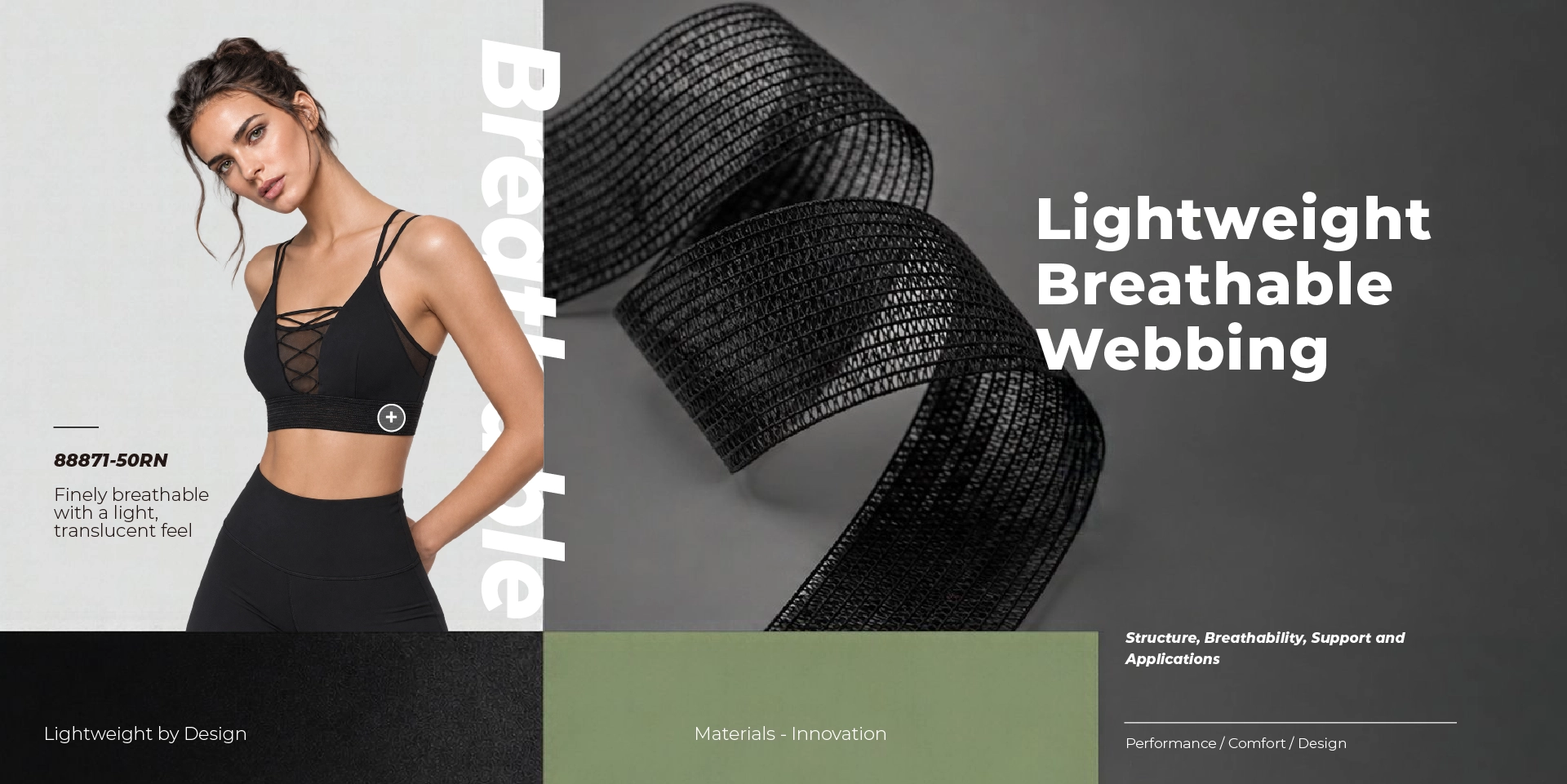
How yarn configuration, weave density and open structures can create lightweight, breathable webbing for sportswear, functional apparel and everyday garments.
What Is Lightweight Breathable Webbing?
Lightweight breathable webbing is designed to reduce bulk while allowing air to move through the structure. Depending on the application, this can be achieved through a combination of yarn configuration, weave density, mesh or open-work structures, and other three-dimensional construction techniques.
In apparel, webbing is no longer simply a fastening or supporting component. It can contribute to fit, comfort, structure and visual design, while also becoming part of a garment's overall aesthetic.
A lightweight construction does not necessarily mean reduced functionality. The objective is to optimize the webbing structure for its intended application, balancing factors such as weight, elasticity, stability, air permeability and appearance.
For applications that require stretch and recovery—such as sports bra underbands, waistbands and cuffs—lightweight breathable elastic webbing can combine controlled stretch with an open or lightweight construction.
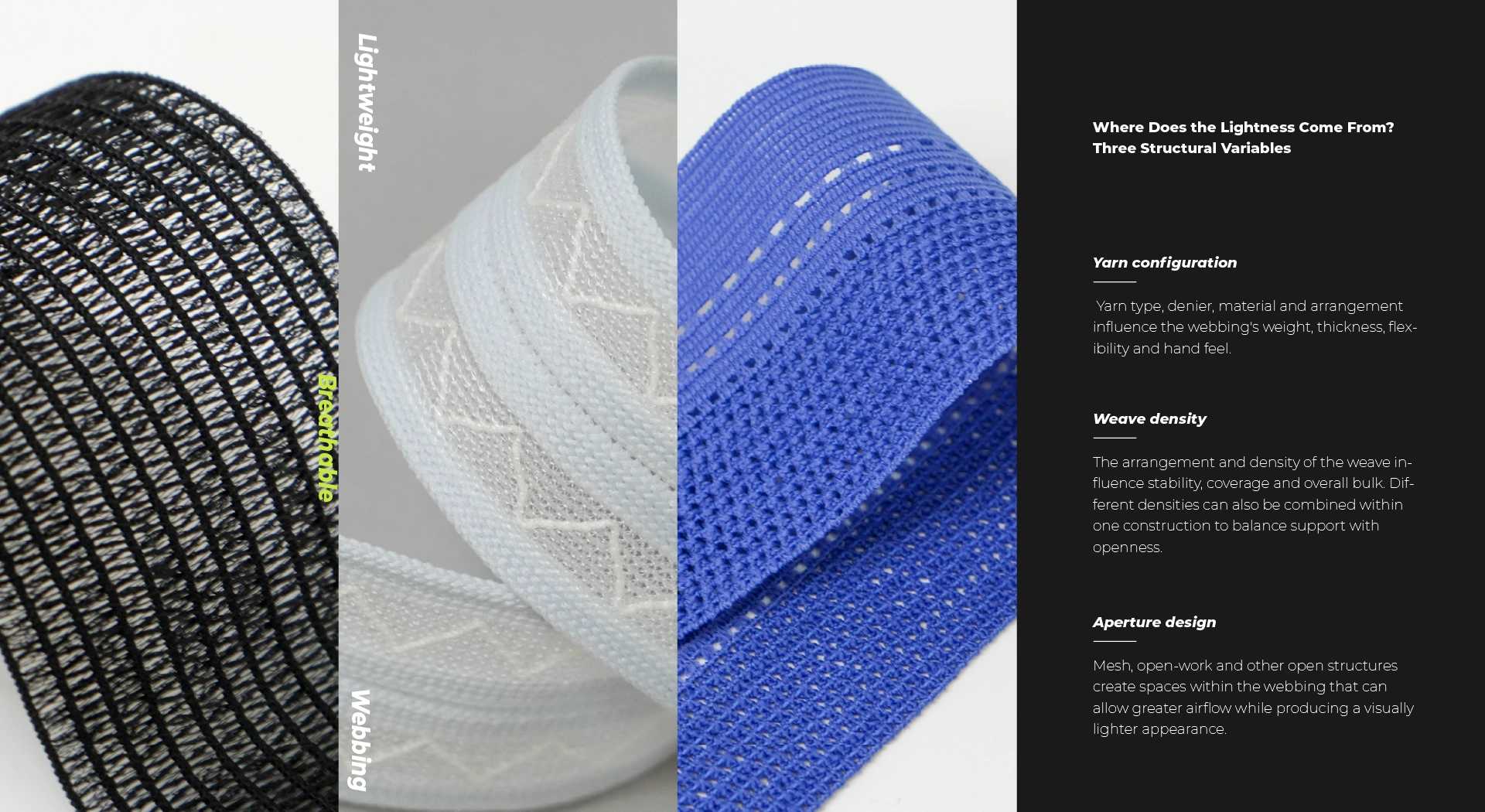
Where Does the Lightness Come From? Three Structural Variables
The weight and breathability of webbing are influenced by several aspects of its construction. Three important factors are yarn configuration, weave density and aperture design.
- Yarn configuration: Yarn type, denier, material and arrangement influence the webbing's weight, thickness, flexibility and hand feel.
- Weave density: The arrangement and density of the weave influence stability, coverage and overall bulk. Different densities can also be combined within one construction to balance support with openness.
- Aperture design: Mesh, open-work and other open structures create spaces within the webbing that can allow greater airflow while producing a visually lighter appearance.
These factors work together rather than independently. A webbing construction can be engineered to achieve a particular combination of support, stretch, openness and visual character according to the requirements of the final garment.
Breathable Structures and Texture Variation: Enhancing Wear Experience and Visual Depth
1. How Do Breathable Structures Increase Air Permeability?
Breathability in webbing is closely related to the openness of its construction. Mesh and open-work structures create apertures through which air can pass, although actual air permeability depends on the complete construction, including yarn characteristics, aperture size, distribution and overall density.
Different structural approaches can create different visual and functional effects:
- Fine, dense apertures: Provide a more subtle open structure while maintaining greater coverage and a clean appearance.
- Larger or more pronounced apertures: Create a more visibly open construction and can provide a stronger mesh or layered visual effect.
- Mixed-density structures: Combine more open and more stable areas within the same construction to balance appearance and structural requirements.
The right balance depends on where the webbing will be used and what role it needs to perform within the garment.
2. How Does Texture Variation Enrich Apparel Detail?
Webbing construction can also be used to create visual and tactile variation. Different weaving methods can produce fine mesh openings, linear patterns, raised textures, layered effects and contrasting areas of density.
This gives designers more options than a conventional flat webbing construction. A breathable webbing can function as both a technical component and a visible design detail, particularly when used along garment edges, panels, waistbands or other areas where the webbing becomes part of the garment's identity.
Lightweight Does Not Mean Losing Support: The Core of Brand Trust
The most common concern consumers have about lightweight products is insufficient support. With the right structural design, however, breathability, elasticity and stability can coexist perfectly:
- High-load areas (e.g. sports bra underbands): use interlaced dense/loose weaves with more stable structures.
- Decorative and brand-recognition areas (e.g. cuffs, necklines, side panels): use more open mesh structures.
Bringing this technical logic into brand storytelling upgrades product communication from a simple "functional claim" to a genuine "technical explanation", effectively resolving consumers' purchase hesitation.
Diverse Applications: From Sportswear to Everyday Casual
Lightweight breathable webbing can be used across a wide range of apparel applications. By adjusting yarn selection, weave density, elasticity and structural configuration, manufacturers can develop constructions for both performance-driven and design-focused garments.
Sportswear
- Application areas: Sports bra underbands, under-bust support bands, waistbands and moisture-wicking panels.
- Design considerations: Air permeability, moisture-wicking, controlled stretch, recovery, support and lightweight construction.
Sportswear often requires a careful balance between comfort and structural performance. Breathable elastic webbing can help designers address these requirements while also providing opportunities for visible branding and distinctive texture.
Functional Apparel
- Application areas: Jacket hem bands, cuff adjustment systems, pocket-edge reinforcement and other functional garment details.
- Design considerations: Structural stability, durability, flexibility and lightweight functionality.
For functional apparel, webbing may need to withstand repeated movement or tension while remaining unobtrusive. Construction can therefore be adjusted according to the specific load and environmental requirements.
Everyday Casual
- Application areas: Neckline binding, waistbands, cuffs, decorative trims and branded webbing.
- Design considerations: Comfort, appearance, texture, flexibility and overall garment aesthetics.
In everyday apparel, webbing can play a more visible design role. Open structures, refined textures and customized patterns can add visual interest while maintaining the functional characteristics required by the garment.

Five Representative Structures and Their Recommended Applications
The following ECI constructions illustrate how different weave arrangements and densities can create varying combinations of openness, stability, texture and visual effect. Actual performance depends on the final construction and intended application.
|
Article No. |
Structural Features |
Visual Impression |
Recommended Applications |
|
41029-40R |
Weave structures of differing density form fine mesh openings while maintaining overall structural integrity. |
Finely breathable, clean and crisp; the horizontal texture blends easily into apparel design |
Sports bra underbands, garment hems, localized panelling |
|
41039-30R |
Varied weave structures create geometric lines and layering |
Fine open-work knit paired with dense edges breaks the flat monotony of conventional webbing |
Sports bra underbands, garment hems, localized panelling |
|
88871-50RN |
Open mesh / grid weave construction with pronounced permeability across the face |
Finely breathable with a light, translucent feel |
Sports bra underbands, yoga pant waistbands |
|
78229-23R |
Central mesh structure paired with linear side configurations |
Minimal lines and a clean appearance, balancing breathability with stability |
Localized apparel panelling, decorative design |
|
78239-33R |
Weave arrangements of differing density create a subtly veiled mesh effect |
Understated layering with a lightweight, refined design quality |
Localized apparel panelling, decorative design |
These examples demonstrate that breathable webbing does not need to follow a single visual formula. By changing the relationship between open and dense areas, manufacturers can create constructions suited to different performance and design requirements.

Frequently Asked Questions (FAQ)
Q1: Does lightweight breathable webbing lose support because it is thinner?
Not necessarily. With the right yarn configuration and weave-density design, bulk can be reduced while retaining the elasticity and structural stability required by the application area (such as a sports bra underband). Lightness is the result of structural optimization, not a sacrifice of physical performance.
Q2: How is the breathability of webbing mainly created?
Breathability is influenced primarily by the openness of the webbing structure. Mesh, open-work and other open constructions create apertures that can allow greater airflow through the webbing.
The actual level of air permeability depends on factors including yarn characteristics, aperture size and distribution, weave density and the overall construction.
Q3: Can lightweight breathable webbing only be used in sportswear?
No. Lightweight breathable constructions can be developed for sportswear, functional apparel and everyday garments.
Depending on the application, the same design principles can be used to create webbing for waistbands, cuffs, garment edges, panels, decorative trims and other apparel components.
Q4: How do I select the right breathable webbing for an apparel product?
A useful starting point is to evaluate five factors:
- Application area: Determine where the webbing will be incorporated and how it will interact with the garment.
- Load and support requirements: Identify whether the webbing needs to provide tension, retention, reinforcement or primarily decorative detail.
- Elasticity and recovery: For elastic applications, determine the required level of stretch and recovery.
- Breathability and openness: Consider how much airflow and structural openness the application requires.
- Appearance and construction: Select the mesh density, texture, pattern, width and overall visual character that fit the garment.
For a new development, these requirements can then be translated into a specific yarn and weave construction and evaluated through sampling.
Turning Structural Language into Product Competitiveness
The weight, permeability, elasticity and visual character of webbing are not accidental. They are influenced by precise decisions about yarn configuration, weave density, aperture design and overall construction.
For apparel brands and product developers, this means the right webbing should be selected based on more than appearance alone. The construction needs to match the functional requirements of the garment while also supporting its desired look and feel.
ECI Elastics brings extensive experience in the development and manufacture of elastic and woven webbing. Our technical approach considers factors such as yarn selection, weave configuration, elasticity, recovery, structural stability, openness and application requirements.
Whether you are selecting an existing construction or developing a customized webbing for a specific apparel application, ECI can help evaluate the required specifications, recommend suitable constructions and support the sampling process.
Looking for lightweight breathable webbing for a specific application? Contact ECI to discuss your requirements or request samples.