Underwire Channeling: How It Determines Bra Support and Garment Life
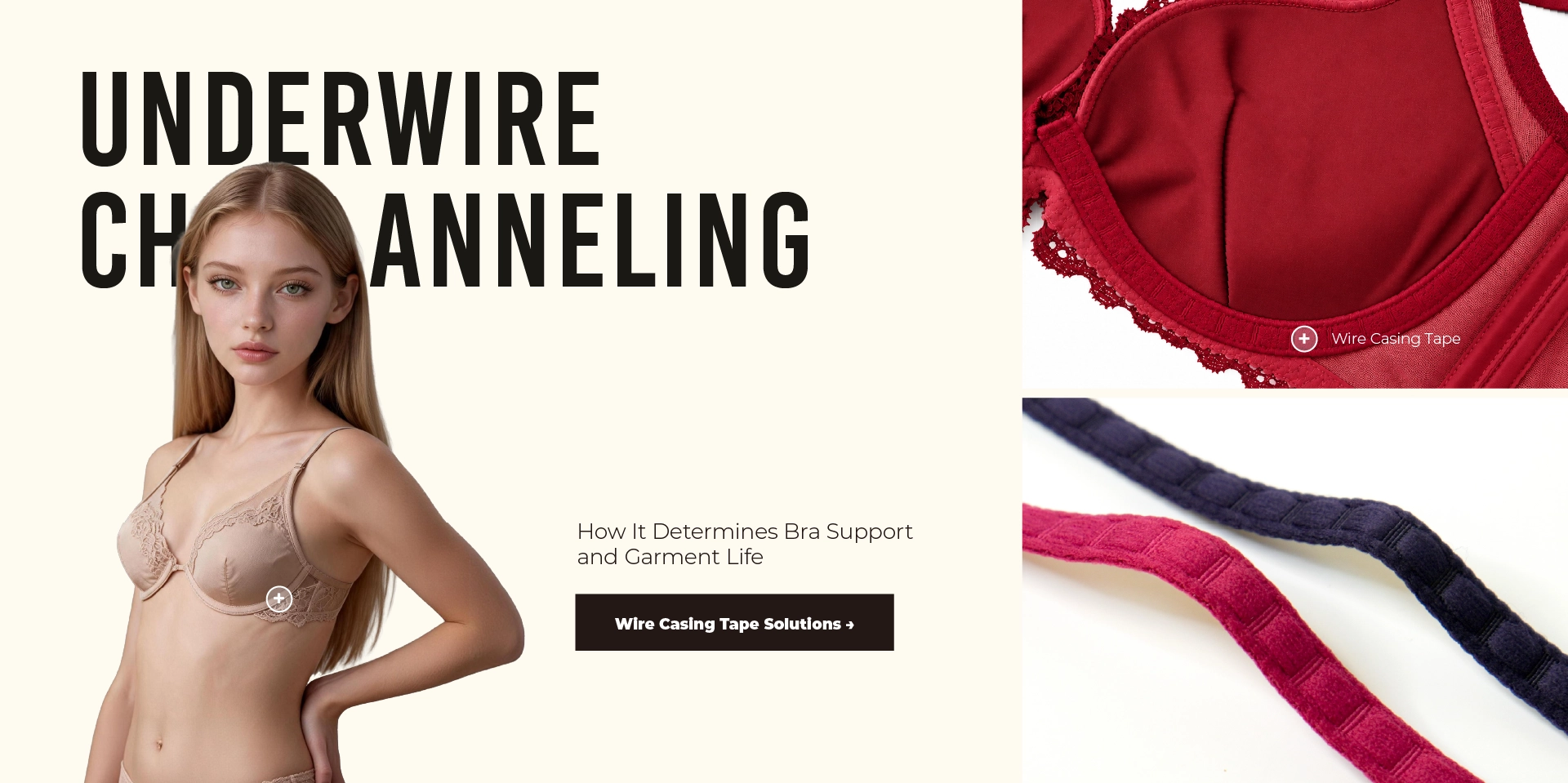
A bra's lift is usually credited to its straps, but most of the work happens along the underband, inside a narrow woven tube almost nobody sees. That tube is the underwire channeling. Its specification decides whether a bra holds its shape for years or lets the wire poke through at the underarm after a handful of washes.
What Is Underwire Channeling?
Short answer: Underwire channeling is a hollow, tubular woven tape stitched along the lower cup line. It holds the underwire at a fixed curvature, isolates the metal from the fabric and the skin, and transfers the wire's rigid support into the garment.
The same component is sold under several names. Pattern makers and technical designers say "underwire channeling". Sourcing documents often say "underwire casing" or "wire casing tape". Chinese-language specifications call it 鋼圈帶 or 鋼圈套帶. All of these describe one product, which ECI lists as Wire Casing Tape. For a broader introduction to the component and its uses outside lingerie, see our earlier guide to underwire casing in lingerie design. This article goes one level deeper, into specification and failure modes.
Where Channeling Sits in a Bra's Load Path
Short answer: The wire supplies rigidity but cannot be stitched to fabric directly. The channeling is the interface that spreads that point-loaded rigidity into a continuous line of support along the rib cage.
Treat the wire and the channeling as one load-transfer unit rather than two separate parts. The wire sets the shape. Channeling decides how faithfully that shape survives movement, laundering, and time. It absorbs the tension and abrasion the garment experiences in wear, which makes it the most heavily loaded trim in a bra.
The commercial cost is easy to underestimate, because getting it wrong shows up in two places that are rarely connected. On the sewing line, channeling with uneven tension curls at the edge, drifts under the needle, and puckers. Machine utilization drops. After shipment, channeling with too little abrasion resistance lets the wire ends work through. The result returns, exchanges, and complaints, all traced back to a component that adds only a few cents to the cost of a garment.
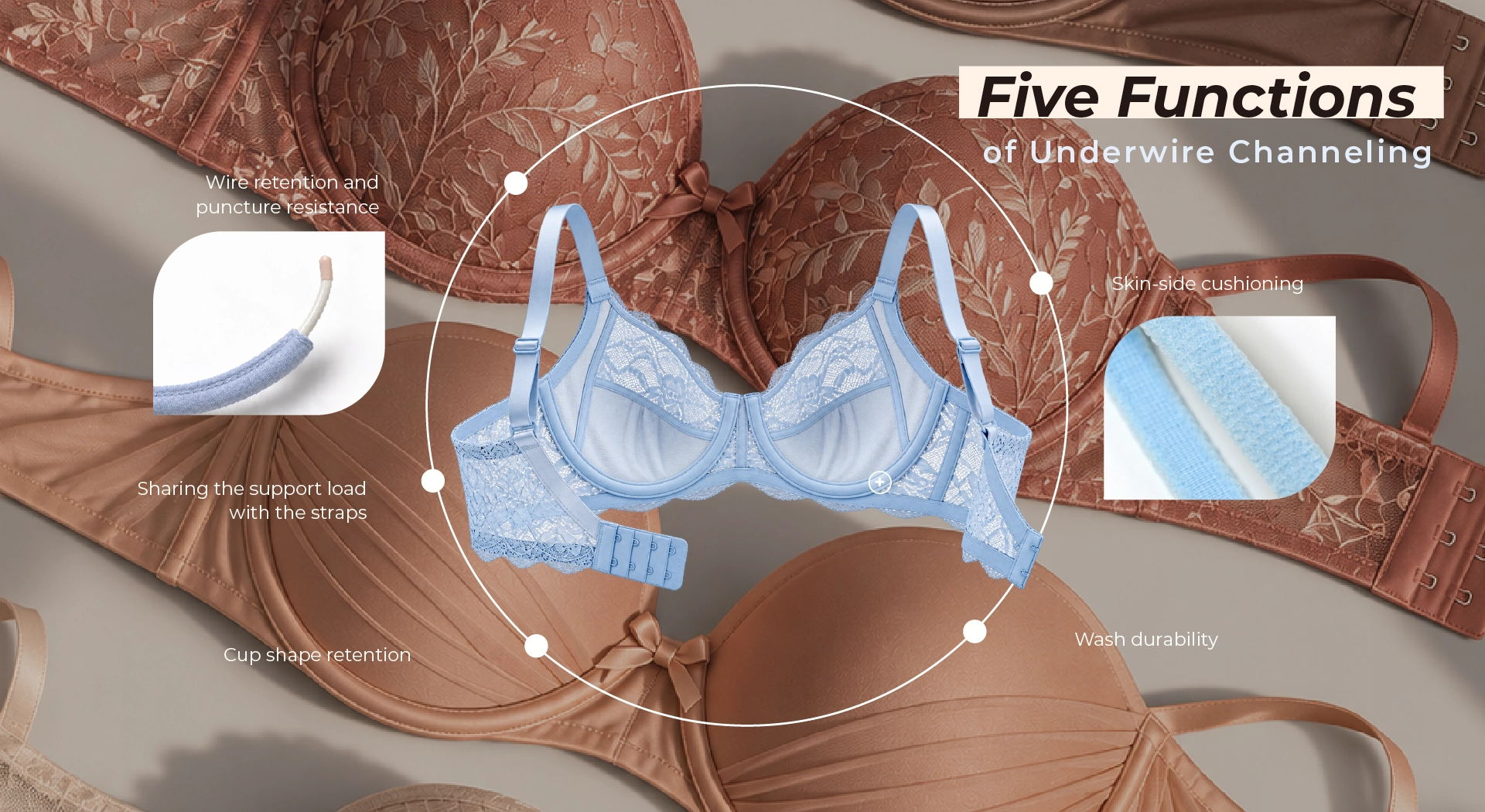
Five Functions of Underwire Channeling
1. Wire retention and puncture resistance
The component has four jobs: enclose the wire, stop it shifting along its length, stop it rotating in place, and keep its ends from breaking through the fabric. Meeting all four requires a sealed, high-tenacity tube matched to the curvature and thickness of the wire. The metal then stays isolated from the cup face fabric. The wire cannot turn inside the channel and load one side unevenly. And the two ends, which push hard against the tape during movement, are held by a weave dense enough to contain them.
2. Sharing the support load with the straps
Carrying and lifting the bust is a job shared between the shoulder straps and the underband channeling zone. Neither does it alone, and pattern makers distribute tension between them. One practical sign shows how much structure the tape itself contributes: some wire-free styles still stitch channeling where a wire would sit, with no wire inserted, because the sewn tape alone adds support along that line.
Two properties decide how well it holds up. Tensile strength, because breathing, bending, and arm swing generate continuous dynamic pull at the underbust. And resistance to abrasion and chemical attack, because the channeling sits against one of the body's higher-perspiration areas and meets mildly acidic sweat, body heat, and repeated friction every day.
3. Cup shape retention
Stiffness and dimensional stability govern how the lower cup curve forms and hold. Channeling that is too soft is pulled offline by needle tension during assembly, leaving the lower cup edge flipped outward or asymmetric. Channeling that is too rigid compresses the rib cage. Channeling that is structurally stable locks the wire curvature at the intended lift point, so the cup resists sagging and side spillage over a long wear life. The balance between rigidity and softness is a pattern-design decision as much as a material one.
4. Skin-side cushioning
Underwires are usually high-carbon steel or memory alloy. They are hard, cold, and press directly on the lower ribs. Purpose-made channeling is finely brushed on the skin side to create a soft napped layer that absorbs the micro-friction generated as the body breathes. The result is fewer underband marks, less redness, and less stinging. That sensory detail decides whether a consumer keeps wearing the garment and buys it again.
5. Wash durability
The three complaints that dominate the bra market are wire-through near the underarm, deformation of the lower wire edge, and cup distortion after washing. All three are usually read as wire failures, and usually are not. Wires rarely break; what fails is the tape around them, when fabric density and abrasion grade are too low for the wire ends to be contained through normal laundering and movement. Specifying a higher channeling grade is one of the cheapest available levers on return rate, complaint cost, and wash life.
Specification Comparison: Two Channeling Tiers
The table below compares high-density woven underwire channeling against standard-grade channeling tape across the properties that show up in production and in the field. It is written to give designers and sourcing teams a defensible basis for material selection rather than a marketing contrast.
|
Evaluation criterion |
High-density woven channeling |
Standard-grade channeling tape |
Effect on garment quality and the end user |
|
Fabric density and puncture resistance |
High needle count and high-density weave; warp and weft tightly interlaced for high bursting strength and abrasion grade |
Lower yarn density and looser construction; the napped face opens up under sustained load |
Substantially reduces wire-through complaints; lower-density tape can abrade the underarm area within a short wear period |
|
Dimensional stability in washing |
High-temperature heat-set, so hot-water and machine-wash shrinkage stays minimal and the tape remains flat |
Less controlled setting; shrinks, twists, and distorts after laundering |
Holds the centering shape over a long wash life; unstable tape leaves the lower cup edge wavy and the bust sagging |
|
Skin-side comfort |
Fine, even nap with low shedding; better moisture management and cushioning |
No nap, or a coarse and sparse nap with poorer breathability |
Fewer pressure marks after a full day of wear; coarse tape can trigger irritation and redness from sweat and friction |
|
Elongation ratio consistency |
Elongation ratio held to a narrow tolerance batch to batch, so the sewn curve reproduces the pattern |
Elongation ratio drifts high or low between batches and is hard to reproduce |
A ratio that runs too high or too low changes the sewn curvature and angle at the lower cup, it is a documented source of customer complaints |
|
Sewability on the line |
Flat tape body with crisp, pucker-resistant edges; suited to high-speed automated sewing |
Stretches and distorts easily with curling edges, causing needle drift and skipped stitches |
Raises line utilization and first-pass yield; unstable tape increases rework and scrap cost |
Engineering and Customization
Short answer: For a narrow-fabric mill, channeling is the product that demonstrates real textile engineering. It has to be woven flat and stable enough to sew at speed, and sized tightly enough to hold a specific wire gauge.
Sewability
Velvet binding tape, the traditional substitute, tends to pucker or twist in multi-layer sewing because its elasticity is uneven across the width. Purpose-woven channeling has a flat tape body and stable warp and weft tension. It feeds smoothly under twin- or triple-needle high-speed machines, bonds cleanly with cup lace or face fabric, resists wave marks, and measurably raises utilization on the assembly line.
The assembly sequence explains why this matters. The channeling is stitched into position first, and the wire is inserted afterward. So the tape has to stay flat and true to size while it is being sewn, then hold the wire without shifting or rotating once it is in place. Elongation ratio consistency is part of the same requirement. If the ratio drifts between batches, the same pattern piece produces a different sewn curve.
Material options and customized specifications
A lightly lined lace bra, a sports support bra, and a deep-V push-up each place different demands on the same component:
- Dimensions. Internal channel width is matched to the wire. Common tape widths include 10 mm and 12 mm, and thickness and channel tolerance can be customized.
- Yarn selection. Nylon is the mainstream yarn for intimate apparel channeling because of its hand feel, abrasion resistance, and dyeing behavior. Polyester constructions are available where the garment specification calls for them. Functional options include antibacterial, odor-control, and moisture-wicking fibers.

How to Specify Channeling: A Short Checklist
Six items cover most of what a technical pack needs to state:
- Tape width and internal channel width, matched to the wire gauge and its end diameter.
- Tape thickness and channel tolerance, so the wire neither binds nor slides.
- Fabric density and abrasion grade, with the intended wash cycle count as the reference condition.
- Nap specification on the skin-side face, including shedding behavior.
- Heat-set condition and maximum permitted shrinkage after laundering.
- Yarn type — nylon or polyester — and any functional finish such as antibacterial or moisture-wicking.
Frequently Asked Questions
When the wire pokes out at the side or underarm, is that a wire problem or a channeling problem?
In most cases it is the channeling, specifically insufficient abrasion resistance or too low a fabric density. The wire itself is normally metal or high-tenacity resin and rarely breaks. In everyday wear and washing, the wire ends continuously push against and rub the inner wall of the channel. If the tape uses a low-density construction with no abrasion reinforcement, the fiber structure is pushed apart under repeated friction until the ends work through. High-density, tear-resistant channeling addresses the failure at its actual cause.
What is the difference between underwire channeling and bra binding tape?
They differ in structural form, mechanical duty, and skin contact. Binding tape is generally a single-layer woven or knitted elastic tape used to wrap a cut fabric edge, prevent fraying, and finish the appearance; its load is even elastic edge tension. Channeling is a hollow, tubular, double-layer woven tape with a precisely sized internal channel. Its outer layer carries high point thrust and tensile load, while the inner face needs a micro-brushed nap for skin-side cushioning. Substituting one for the other is a common source of fit and durability failures.
Why does channeling grade affect line yield at a bra factory?
Two things: dimensional stability and elongation ratio consistency. Precision heat-setting under controlled tension means the tape resists lengthwise stretch and edge curling under the pull of a high-speed machine. Operators can then sew accurately along the lower cup curve in a single pass. An elongation ratio that drifts high or low between batches has the opposite effect. The same pattern piece yields a different sewn curve and angle, a known source of rework and customer complaints.
Do soft wires and memory-alloy wires also need purpose-made channeling?
Yes. Wires of any material need a channel for protection and retention. Soft wires and memory alloys are less rigid than traditional carbon steel, but they still shift and rub laterally during dynamic wear. Without a tubular channel providing a stable physical path and a skin-side barrier, a soft wire can still pull the cup out of shape or press directly on the skin.
What yarn is underwire channeling usually woven from?
Nylon dominates the intimate apparel market for this component. It gives the soft hand feel required against the skin, holds a fine nap well, and offers the abrasion resistance the wire ends demand. Polyester constructions are available where a garment specification or a brand material policy calls for them. Yarn choice is confirmed per item alongside width, density, and finish, because it changes hand feel, dyeing behavior, and abrasion performance together.
Request Samples and Technical Support
Garment yield and brand reputation begin with the trim details. ECI Elastic Co., Ltd. is a narrow-fabric manufacturer based in Changhua, Taiwan, with vertically integrated production across Taiwan, Zhuhai, and Vietnam, supplying high-density, abrasion-resistant underwire channeling with customized development of width (10 mm, 12 mm, and others), thickness, fabric density, nap, and yarn selection.
- Samples: full specification and color cards plus engineering samples for line sewing trials.
- Technical support: the ECI technical team works with pattern makers and sourcing staff to evaluate the optimal channeling specification and improve sewing yield.
Contact ECI to discuss underwire channeling for your next program: https://www.ecigroup-global.com/en/contact-us.html
OTHER NEWS
Lightweight Breathable Webbing: Structure, Breathability, Support and Applications
What Does SS27 Mean? Fashion Season Codes and the Designer Vocabulary That Comes With Them