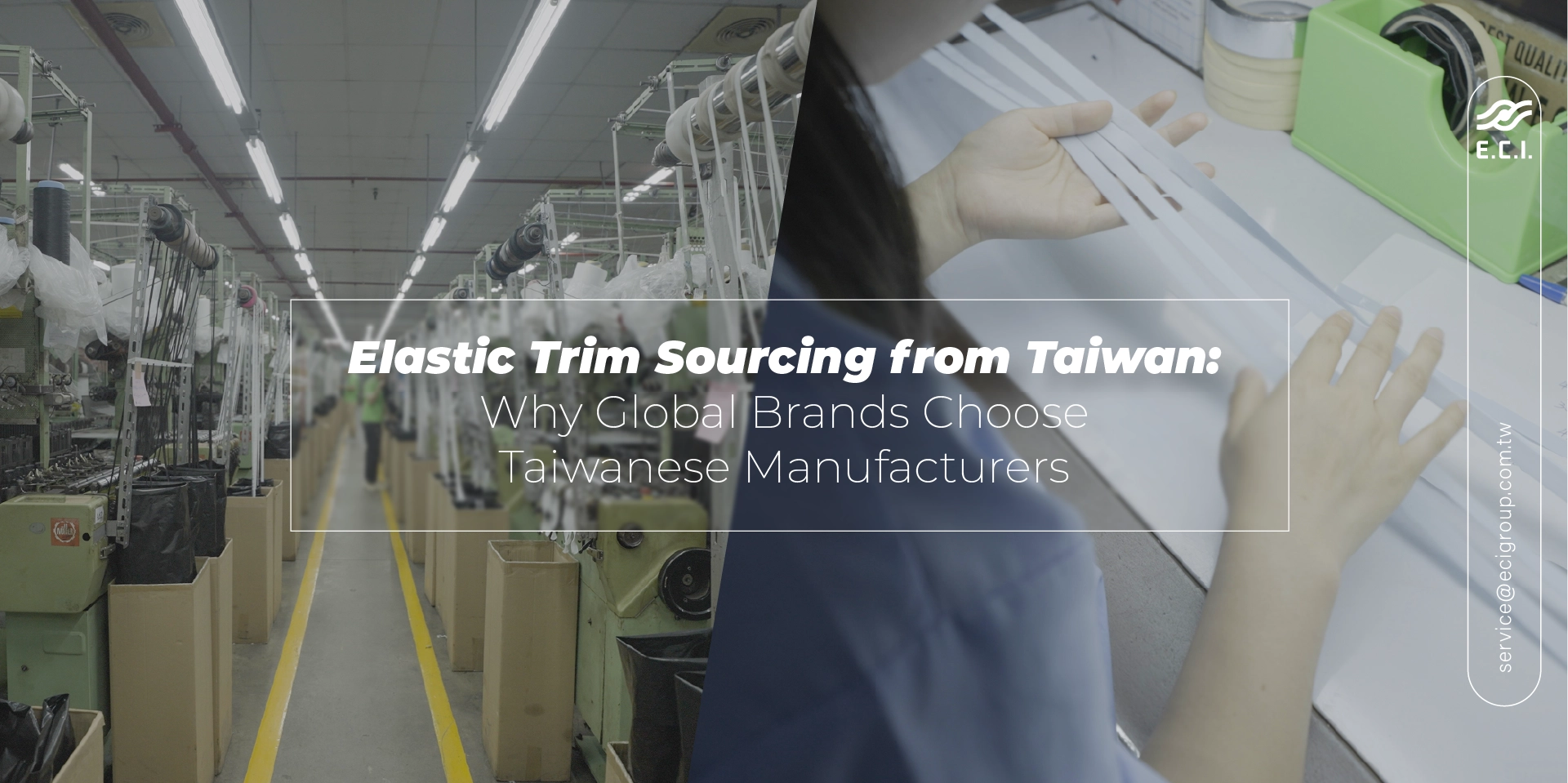
Elastic Trim Sourcing from Taiwan: Why Global Brands Choose Taiwanese Manufacturers
When global apparel brands evaluate where to source their elastic tapes and narrow fabrics, Taiwan consistently appears at the top of the list. This is not an accident. Taiwan’s textile industry has spent decades building capabilities that are difficult to replicate: deep vertical integration, world-class R&D infrastructure, stringent quality systems, and a culture of continuous material innovation.
For sourcing managers evaluating elastic tape manufacturers, Taiwan offers a combination of technical sophistication and supply reliability that few other manufacturing regions can match. This article explores the specific advantages that make Taiwanese narrow fabric manufacturers a preferred partner for the world’s most demanding apparel brands.
Taiwan’s Position in the Global Textile Supply Chain
Taiwan’s textile industry is one of the most technologically advanced in the world. While the country’s garment manufacturing has largely moved offshore over the past three decades, Taiwan has retained and strengthened its position in high-value upstream segments: functional yarns, performance fabrics, and specialty trims including elastic tapes and narrow fabrics.
This shift was deliberate. Rather than competing on labor cost, Taiwanese manufacturers invested in R&D, automation, and technical differentiation. The result is a manufacturing ecosystem where innovation happens at the material level—new yarn formulations, advanced knitting and weaving structures, engineered stretch properties, and sustainable material development. For narrow fabric manufacturers specifically, this translates into a level of product sophistication and customization depth that brands increasingly require.
Taiwan is also home to a dense network of yarn suppliers, dyeing specialists, finishing houses, and testing laboratories. This proximity allows manufacturers to iterate quickly, source specialty inputs without international shipping delays, and maintain tight control over the entire production chain.
Certification Standards That Meet Global Brand Requirements
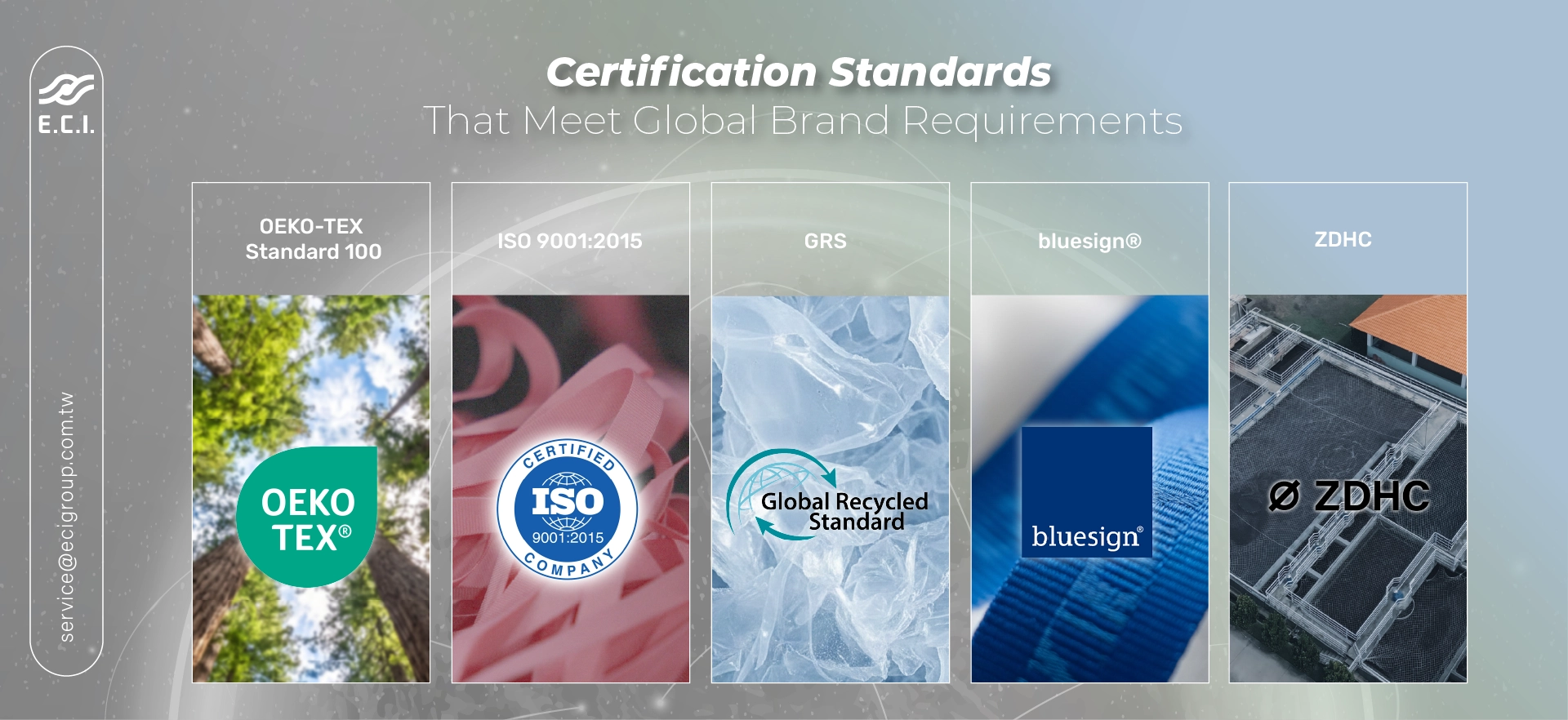
One of the strongest reasons global brands source from Taiwanese manufacturers is the certification infrastructure. Major international brands—particularly those in athletic, performance, and premium apparel segments—maintain some of the most rigorous supplier compliance requirements in any industry. These requirements cover environmental management, chemical safety, labor standards, and product testing, and they are enforced through regular third-party audits.
Taiwanese elastic tape manufacturers are well-positioned to meet these demands because the certification culture is deeply embedded in the industry. The key certifications that global brands typically require include:
- OEKO-TEX Standard 100 — Verifies that textile products are free from harmful levels of over 100 substances. Essential for any product that contacts skin, including elastic tapes used in waistbands, bra straps, and back neck tape.
- ISO 9001:2015 — Validates consistent quality management systems across the entire production process, from incoming raw materials through finished goods.
- GRS (Global Recycled Standard) — Third-party verification of recycled content throughout the supply chain. Required by any brand making recycled-content claims on product labeling or marketing.
- bluesign® — Demonstrates responsible resource use and chemical management in manufacturing. Increasingly required by leading outdoor and performance brands.
- ZDHC (Zero Discharge of Hazardous Chemicals) — Ensures wastewater and chemical management meet the most stringent environmental standards. Many major global brands require ZDHC compliance from all Tier 2 suppliers, including trim manufacturers.
What distinguishes top Taiwanese manufacturers is not just holding these certifications—it is staying ahead of evolving requirements. Global brands regularly update and tighten their restricted substance lists, environmental performance benchmarks, and social compliance standards. The best Taiwanese suppliers invest in compliance teams that track these changes proactively, ensuring they meet updated requirements before audit deadlines rather than scrambling to catch up.
R&D Depth and Advanced Material Innovation
Taiwan’s R&D investment in textiles is one of the country’s most significant competitive advantages—and one of the hardest for other regions to replicate. Taiwanese narrow fabric manufacturers operate dedicated R&D departments that go beyond simply responding to customer requests. They actively develop new materials, yarn formulations, and construction techniques that solve emerging industry challenges.
One area where this R&D depth is particularly visible is in the development of elastane-free elastic tapes. Traditional elastic tapes rely on elastane (spandex/Lycra) blended with polyester or nylon to achieve stretch and recovery. This works well functionally, but creates a significant end-of-life problem: multi-fiber compositions are extremely difficult to recycle. The elastane must be separated from the base yarn before either material can be recycled—a process that is technically complex and economically unviable at scale for most recyclers.
Taiwanese manufacturers have been pioneering mechanical stretch alternatives that achieve elastic properties through yarn structure and knitting or weaving construction rather than elastane content. These elastane-free elastic tapes use single-material compositions—typically 100% polyester—that can be recycled through standard polyester recycling streams without fiber separation.
This is not a universal replacement for elastane-based tapes. Applications requiring high elongation and aggressive recovery, such as compression garments, still benefit from elastane content. But for a wide range of everyday applications— back neck tapes, binding tapes, and light-stretch trims—elastane-free alternatives already deliver comparable performance while dramatically improving end-of-life recyclability. It is the kind of forward-looking material innovation that positions Taiwanese manufacturers at the intersection of performance and sustainability.
Vertical Integration and Quality Control
The most capable Taiwanese elastic tape manufacturers are vertically integrated, controlling the production process from yarn selection through weaving or knitting, dyeing, finishing, printing, and quality inspection. This end-to-end control is critical for several reasons:
- Consistency — When every production stage happens under one roof, handoff errors between subcontractors are eliminated. The manufacturer can trace any quality issue back to its exact source and correct it immediately.
- Speed — Vertical integration shortens lead times significantly. Custom sample development that might take 3–4 weeks through a fragmented supply chain can often be completed in 7–14 days by an integrated manufacturer.
- Customization — Controlling every process stage means the manufacturer can engineer bespoke solutions: custom yarn blends, precise Pantone color matching, unique jacquard patterns, specific stretch-and-recovery profiles, and specialty finishes like silicone coating, embossing, or digital printing.
Taiwanese manufacturers also invest heavily in in-house testing laboratories equipped to run stretch and recovery testing, colorfastness evaluation, tensile strength measurement, and chemical safety screening—all before products ship. This quality assurance infrastructure gives brands confidence that incoming trims will meet specifications consistently, batch after batch.
Case Study: ECI Elastic — Over 50 Years of Taiwanese Manufacturing Excellence
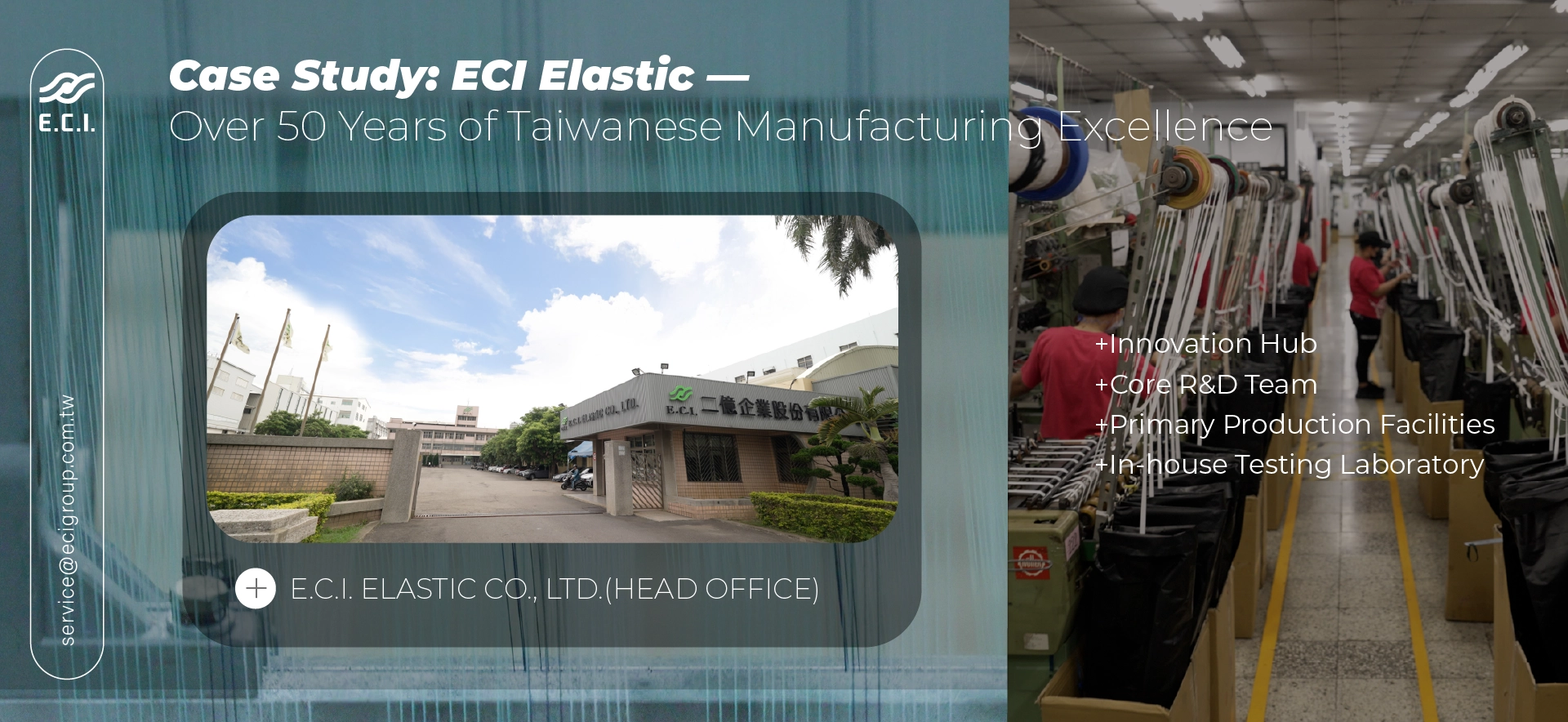
ECI Elastic is a Taiwanese narrow fabric manufacturer that exemplifies the strengths outlined in this article. Founded in 1974 and headquartered in Changhua County, Taiwan, ECI has grown from a single-facility operation into a global manufacturer with production sites in Taiwan, Vietnam, and China, supported by professional representative agencies in Korea and France to ensure localized service and market expertise.
ECI’s Taiwan headquarters serves as the company’s innovation hub, housing its core R&D team, primary production facilities, and in-house testing laboratory. This is where new materials are developed, production processes are refined, and custom solutions are engineered for global brand partners.
On the compliance front, ECI maintains OEKO-TEX Standard 100, ISO 9001:2015, and GRS certifications, with ZDHC-compliant chemical management across its facilities. The company’s compliance team proactively tracks evolving requirements from major global brand programs, ensuring certifications and restricted substance compliance stay current ahead of audit cycles. For brands with the most demanding supplier requirements, this proactive posture eliminates the risk of supply disruption from failed audits or expired certifications.
In material innovation, ECI has developed elastane-free elastic tape constructions that use mechanical stretch properties to achieve elastic performance from single-material compositions. The company has also pioneered the production of recycled fancy yarn from its own post-industrial waste—a closed-loop process that diverts production waste from landfill while creating a verified recycled input material for its tape products.
ECI’s product range spans 16+ categories including elastic tapes, waistbands, bra straps, binding tapes, drawcords, back neck tape, shoelaces, and decorative trims—all produced in-house with full vertical integration from yarn to finished product.
What to Look for When Sourcing Elastic Trims from Taiwan
Not all Taiwanese manufacturers are equal. When evaluating potential suppliers, prioritize these factors:
- Verified certifications — Ask for current certificates, not just claims. Confirm OEKO-TEX, ISO, and GRS certifications are active and verifiable with the issuing body.
- In-house R&D capability — Can the manufacturer develop custom materials and constructions, or do they only produce standard products from a fixed catalog?
- Testing infrastructure — Do they operate an in-house lab for stretch, colorfastness, tensile, and chemical safety testing? Manufacturers who test proactively catch problems before they reach your garment factory.
- Sustainability roadmap — Beyond current certifications, what are they investing in? Recycled materials, closed-loop manufacturing, and mono-material development signal a manufacturer thinking about where the industry is headed, not just where it is today.
- Multi-region support — If you manufacture garments across multiple countries, does the Taiwanese supplier have satellite production or distribution in those regions? This simplifies logistics and reduces lead times for your garment factories
Frequently Asked Questions
Why is Taiwan considered a leading source for elastic tape and narrow fabrics?
Taiwan’s textile industry has invested decades in R&D, advanced manufacturing technology, and certification infrastructure. While garment production has largely moved to lower-cost regions, Taiwan retained and strengthened its position in high-value upstream segments like functional yarns, performance fabrics, and specialty trims. Taiwanese narrow fabric manufacturers are known for vertical integration, material innovation, and the ability to meet the compliance requirements of the world’s most demanding brands.
What certifications should I expect from a Taiwanese elastic tape manufacturer?
At minimum, look for OEKO-TEX Standard 100 (chemical safety), ISO 9001:2015 (quality management), and GRS (Global Recycled Standard) if recycled content is required. Leading manufacturers also maintain bluesign and ZDHC compliance. Certifications should be current, verifiable, and backed by regular third-party audits.
What are elastane-free elastic tapes and why do they matter?
Elastane-free elastic tapes achieve stretch and recovery through yarn structure and knitting or weaving construction rather than blending elastane (spandex) into the yarn. Because they use a single material—typically 100% polyester—they can be recycled through standard recycling streams without requiring fiber separation. This addresses one of the biggest barriers to textile recycling: multi-fiber compositions that are technically and economically impractical to separate at end of life.
How long does custom sample development typically take with a Taiwanese manufacturer?
Vertically integrated Taiwanese manufacturers can typically produce custom samples in 7–14 days from specification submission, depending on complexity. Standard modifications like color or width changes are often faster. Fully custom products requiring new yarn blends, jacquard patterns, or specialty constructions may take up to 21 days.
Explore Taiwanese Manufacturing for Your Elastic Trim Needs
Taiwan’s narrow fabric manufacturers offer a combination of technical sophistication, certification depth, material innovation, and production reliability that supports the most demanding sourcing programs in global apparel. For brands prioritizing quality, compliance, and sustainability in their trim supply chain, Taiwan remains a strategic sourcing decision.
To explore how ECI Elastic can support your elastic trim requirements from our Taiwan production base, browse our product range or contact our team to discuss your project specifications and request samples.
OTHER NEWS

Lightweight Breathable Webbing: Structure, Breathability, Support and Applications
What Does SS27 Mean? Fashion Season Codes and the Designer Vocabulary That Comes With Them